
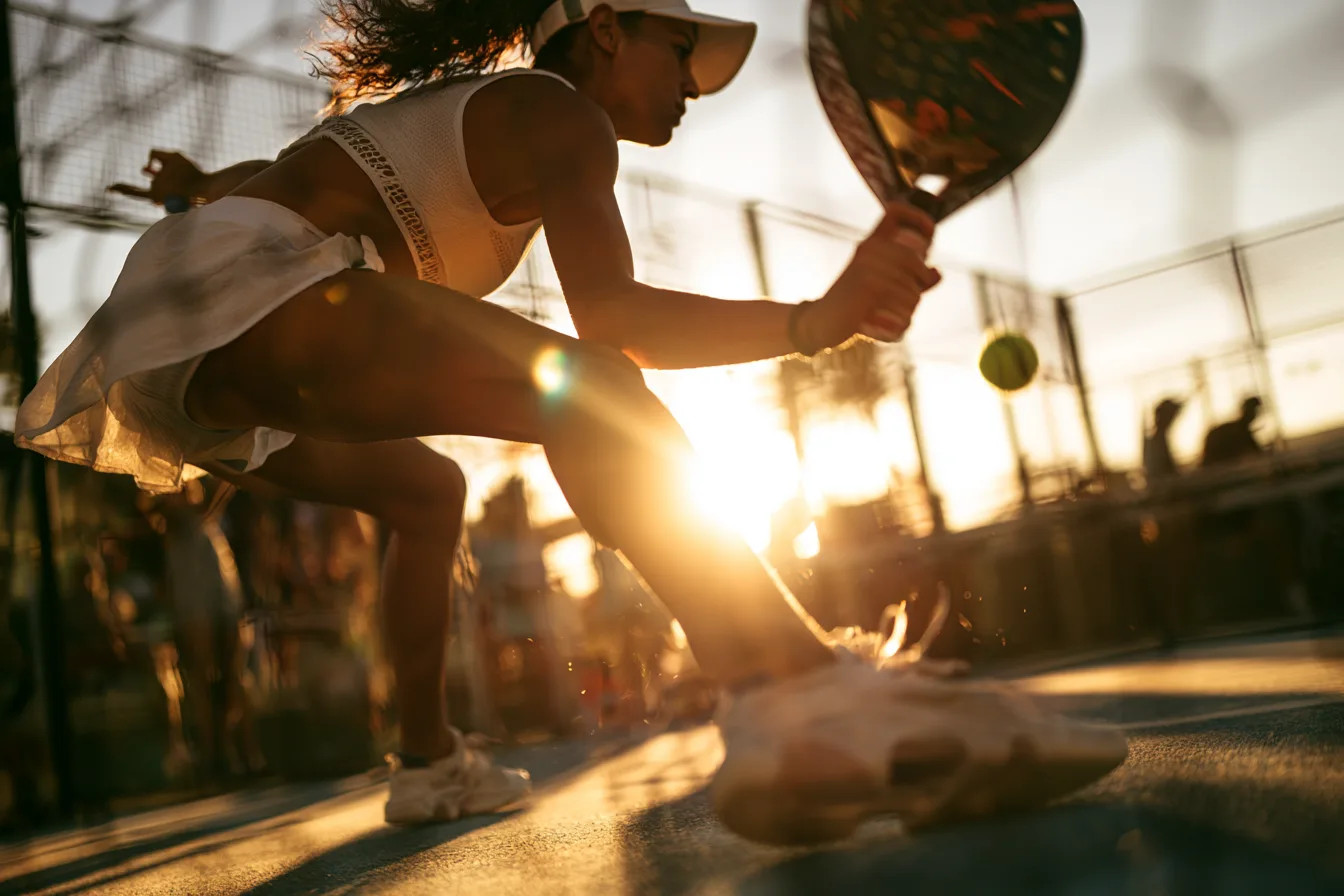
Forehand, volley, bandeja, Víbora, lob, bajada: padel has many strokes with their own names. As a beginner, you do not need to master all of them at once. More important is choosing the right stroke for your position and situation.
The simplest way to organise them:
- Defence: Stabilise the rally from the back of the court
- Transition: Push opponents away from the net and move forward yourself
- Offence: Apply pressure at the net and hold the position
Not every stroke is strictly offensive or defensive. A good lob often starts as defence and ends with your team at the net. A bandeja may look spectacular, but its main purpose is often to keep your attacking position.
Position first, stroke second
In padel, the team at the net usually controls the rally. Research supports this: a systematic review of padel performance analysis describes the volley as the most frequent stroke and links successful pairs with more attacking actions and net position.
That does not mean rushing forward at every opportunity. A better sequence is:
- Buy time at the back
- Play a good transition ball
- Move forward together with your partner
- Apply pressure at the net with controlled strokes
The most important padel strokes at a glance
| Stroke | Typical position | Main purpose | Beginner priority |
|---|---|---|---|
| Forehand and backhand | Back of court | Stabilise rallies | Very high |
| Wall ball / salida de pared | Back of court | Use the opponent's pace | Very high |
| Lob | Back or transition | Push opponents away from the net | Very high |
| Chiquita | Back or transition | Play low at the opponents' feet | Medium |
| Volley | At the net | Apply pressure and open angles | Very high |
| Bandeja | Mid-court / net | Control a lob and stay forward | High |
| Víbora | Mid-court / net | Create more pressure with spin | Later |
| Smash | Near the net | Finish a short high ball | Later |
| Bajada | After a high wall rebound | Attack from defence | Later |
Defensive strokes: stay calm at the back
Defence is first about time, control, and good positioning. A hard ball is not automatically a good ball. From the back, the team that stays calm and waits for the right chance often wins.
Forehand and backhand
Play these basic strokes after the bounce. Keep the motion compact and contact the ball in front of your body. A long tennis-style backswing costs unnecessary time on the smaller padel court.
Focus on these points:
- Turn sideways early
- Prepare the racket below the expected contact height
- Swing forward with a relaxed arm
- Play with enough height to clear the net safely
- Return to a neutral ready position after the shot
The middle and the space behind the opposing net players are useful targets. The middle reduces angles and can create uncertainty between opponents.
Salida de pared: the ball after the back wall
The salida de pared is a basic stroke after the ball rebounds from the back wall. It feels unusual at first, but quickly becomes one of the most important tools in padel.
Give the ball room. If you stand directly against the glass, it traps you. Move with the ball, turn your shoulders, and wait for it to come forward off the wall. Only then play a calm forehand or backhand.
Under the official FIP rules, a ball remains in play after its first bounce when it then touches a wall or mesh. You only need to return it before its second bounce.
Remember: The back wall is not your opponent. It gives you time.
Lob: the most important transition ball
The lob is a high ball over the net players. Its purpose is not merely to save the point. A deep lob forces opponents back and can open the net for you.
A study of 2,063 lobs from ten Premier Padel matches describes the lob as a central way to regain the net position. Professional data is not a direct instruction for beginners, but it shows the tactical importance of this apparently simple stroke.
Make your lob more reliable:
- Move underneath the ball instead of lifting it only with your wrist
- Swing calmly forward and upward with an open racket face
- Allow enough height over the opponents
- Aim deep into the court without forcing the baseline
- Move forward only when the lob actually clears the opponents
A lob through the middle is often safe for beginners: the net is lower there, the angle out is smaller, and opponents must decide who covers the overhead.
Chiquita: low at the feet
The chiquita is a slow, flat ball played at the feet of the net players. It is not meant to produce an immediate winner. Instead, it forces a low volley that often has to be played upward.
Play the chiquita only when you have time and balance. If it stays too high, the opponent gets an easy attacking volley. If it works, your team can move forward and attack the next weak ball.
Transition: when should you move to the net?
Transition is the moment between defence and attack. Many beginners lose points here because one player moves forward while the partner stays back.
Move forward together:
- After a deep lob: Both move towards the net and watch the overhead.
- After a good chiquita: Both close in once the opponent must hit below net height.
- After a weak lob: Do not keep running blindly. Stop, split-step, and defend the next ball.
The split-step is a small two-foot hop just before the opponent's contact. Land with bent knees so you can start quickly in either direction. Do not keep moving forward while the opponent is hitting.
Bajada: attack after the back wall
The bajada is played when an opponent's lob rebounds high from your back wall. Instead of merely returning it, you contact the ball at a comfortable height and play with pace into space or at the opponents' feet.
For beginners, the order matters: read the wall rebound safely first, then accelerate. If the ball stays low or you have to contact it behind your body, a controlled lob is usually the better choice.
Offensive strokes: apply pressure at the net
At the net, you do not need to win every ball. Your first objective is to keep opponents back and create an easier next ball.
Volley: short, compact, controlled
For a volley, contact the ball before it bounces. Keep the racket in front of your body, turn your shoulders slightly, and block with a short forward movement. Large backswings make contact late and uncontrolled.
Good volley targets:
- Deep at the feet
- Through the middle
- Into open corners
- Deep into the back wall when under pressure
Do not try to finish the first volley immediately. The first volley keeps opponents back, the next one opens space, and the easy ball is the one you finish.
Bandeja: stay forward instead of taking every risk
The bandeja is a controlled overhead with slight underspin. You usually play it when opponents lob over you, but the ball is not short enough for a smash.
Its main purpose is to neutralise the lob and let you return to the net position.
Basic technique for beginners:
- Turn sideways early and keep both hands up
- Get behind the ball with side steps; do not cross backwards or run blindly
- Contact the ball high and slightly to the side in front of your body
- Play deep with around 60 to 70 percent pace
- Close forward together immediately after the shot
Good targets are the deep middle or the corner where side and back wall meet. Control matters more than heavy spin.
Víbora: the more aggressive bandeja
The Víbora, Spanish for viper, is also an overhead, but uses more sidespin and higher racket speed. After touching the glass, the ball often stays low and becomes harder to defend.
Compared with the bandeja, contact is usually slightly farther in front and to the side. The forearm and shoulder accelerate more through the ball.
For beginners, learn a reliable bandeja first. An uncertain Víbora often produces net errors or opens the court. Add it later for a slightly shorter lob from a stable position.
Smash: only the right ball deserves full power
A smash makes sense when the lob is short, you can get underneath it, and you are close enough to the net. The farther back you contact the ball, the easier it is for opponents to use the back wall and return it.
Start with a controlled flat smash into open space. The spectacular X3 out of the court or X4 over the back wall is not a beginner target. Good selection beats raw power.
Bandeja, Víbora, or smash?
| Situation | Best choice | Why? |
|---|---|---|
| High, deep lob | Bandeja | Control and time to return to the net |
| Slightly shorter lob, stable position | Víbora | More spin and pressure are possible |
| Short lob, contact clearly in front | Smash | Good chance to finish the point |
| Lob pulls you far back | Bandeja or defensive ball | A smash from a poor position invites the opponent |
When unsure, choose the bandeja. It has the widest tactical safety margin.
Seven common beginner mistakes
1. Smashing every high ball
A deep lob is rarely a good smash ball. Use the bandeja and keep your position.
2. Taking a big backswing on the volley
There is no time at the net. Keep the racket in front, turn the shoulders, and block briefly.
3. Running backwards towards the lob
You lose balance and court awareness. Turn sideways early and move back with controlled side steps.
4. Playing the lob too flat
A flat lob becomes the opponent's perfect bandeja. Give it deliberate height and depth.
5. Sprinting forward after every lob
Only a good lob opens the net. If it stays short, stop and defend the next ball.
6. Taking two different zones as a pair
If one player is at the net and one is back, a large diagonal gap appears. Move forward and back together.
7. Confusing technique with maximum pace
Control, placement, and recovering your position win more rallies than one hard shot.
A simple 50-minute training plan
You need a partner, a basket of balls, and clear targets:
- 10 minutes of basic strokes: Cross-court forehands and backhands with compact movement
- 10 minutes of wall balls: Start controlled after the back wall, then return with a salida
- 10 minutes of lobs: Deep through the middle and cross-court from both corners
- 10 minutes of volleys: Alternate forehand and backhand towards marked target zones
- 10 minutes of patterns: Lob, move forward together, bandeja, first volley
Do not count only winners. Count complete, clean sequences. Five controlled repetitions in a row are more valuable than one spectacular shot.
The best learning order
For your first months, this order works well:
- Return forehands, backhands, and wall rebounds reliably
- Develop a high, deep lob
- Play compact forehand and backhand volleys
- Learn the bandeja to protect the net position
- Add the chiquita and bajada as transition strokes
- Only then build the Víbora and different smash variations
If you are new to the sport, our complete padel guide for beginners can help. For the start of every rally, see our step-by-step padel serve guide.
The most important padel strokes at a glance
| Stroke | Typical position | Main purpose | Beginner priority |
|---|---|---|---|
| Forehand and backhand | Back of court | Stabilise rallies | Very high |
| Wall ball / salida de pared | Back of court | Use the opponent's pace | Very high |
| Lob | Back or transition | Push opponents away from the net | Very high |
| Chiquita | Back or transition | Play low at the opponents' feet | Medium |
| Volley | At the net | Apply pressure and open angles | Very high |
| Bandeja | Mid-court / net | Control a lob and stay forward | High |
| Víbora | Mid-court / net | Create more pressure with spin | Later |
| Smash | Near the net | Finish a short high ball | Later |
| Bajada | After a high wall rebound | Attack from defence | Later |
Frequently asked questions about padel techniques
Which padel stroke matters most for beginners?
The lob. It gives you time under pressure, pushes opponents away from the net, and allows the move from defence into attack. Reliable basic strokes and compact volleys come next.
What is the difference between a bandeja and a Víbora?
The bandeja is more controlled and mainly protects the net position. The Víbora is more aggressive and uses stronger sidespin. Its goal is more pressure, so it requires a better contact point.
Is the bandeja defensive or offensive?
It is an offensive maintenance stroke: you play it from the front half of the court, but not primarily as a winner. It prevents the opponent's lob from pushing you permanently away from the net.
When should I play a smash?
When the lob is short, you are well underneath the ball, and you can contact it clearly in front of your body. With a deep lob, the bandeja is almost always safer.
Do beginners need to know the Víbora?
No. A reliable bandeja will help much more at first. Add the Víbora once you can control overheads consistently and recover your position after the shot.
Conclusion: better decisions, not more strokes
Good padel does not begin with the most spectacular technique. It begins with one simple question: Am I defending, changing position, or attacking?
From the back, wall balls and lobs create calm. A good chiquita or deep lob opens the path forward. At the net, volleys and bandejas maintain pressure. Add the Víbora and smash only when position, timing, and control are ready.
Learn this order, move together with your partner, and your game will improve faster than it would through forced winners.